Introduction to Quadratic Equations and Parabolas
A quadratic equation is a type of equation that contains a variable raised to the power of 2. The general form is ax² + bx + c = 0, where a ≠ 0.
Understanding the properties of a parabola is crucial for understanding many real-world applications.
Learning Modules
Basic Concepts
Learn the basic definitions and properties of quadratic equations and parabolas
Start LearningGraph Transformations
Learn about parabola translations, stretches, and other transformations
Start LearningBasic Concepts
Definition of Quadratic Equations
A quadratic equation is a polynomial equation of the second degree. The general form is:
When a = 0, the equation reduces to a linear equation.
Quadratic Functions
A quadratic function is defined as:
The graph of a quadratic function is a parabola.
Key Points of a Parabola
- Vertex: The point on the parabola where the y-value is at its maximum or minimum. For the function f(x) = ax² + bx + c, the x-coordinate of the vertex is -b/(2a), and the y-coordinate can be found by substituting this x-value into the function.
- Axis of Symmetry: The vertical line passing through the vertex, about which the parabola is symmetric. The equation of the axis of symmetry is x = -b/(2a).
- Direction of Opening: When a > 0, the parabola opens upward; when a < 0, the parabola opens downward.
- Zeros (Roots): The points where the graph intersects the x-axis, i.e., the solutions to f(x) = 0.
Interactive Demonstration
Coefficient Effects
The coefficients a, b, and c in a quadratic function (f(x) = ax² + bx + c) each have unique effects on the shape and position of the parabola. Understanding these effects is crucial for analyzing and manipulating quadratic functions.
The Effect of Coefficient 'a'
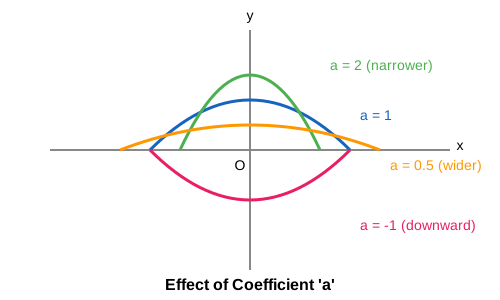
The coefficient 'a' determines the width and direction of the parabola:
- When |a| increases, the parabola becomes narrower
- When |a| decreases, the parabola becomes wider
- When a > 0, the parabola opens upward
- When a < 0, the parabola opens downward
The Effect of Coefficient 'b'
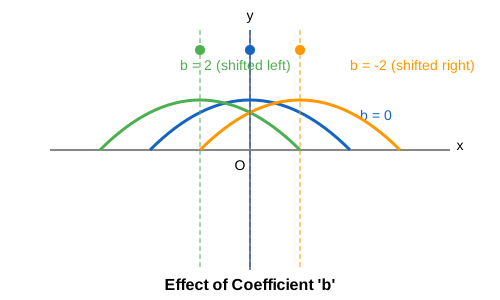
The coefficient 'b' affects the horizontal position of the vertex and the axis of symmetry:
- The x-coordinate of the vertex is given by x = -b/(2a)
- When b increases, the parabola shifts to the left
- When b decreases, the parabola shifts to the right
- When b = 0, the axis of symmetry passes through the y-axis (x = 0)
The Effect of Coefficient 'c'
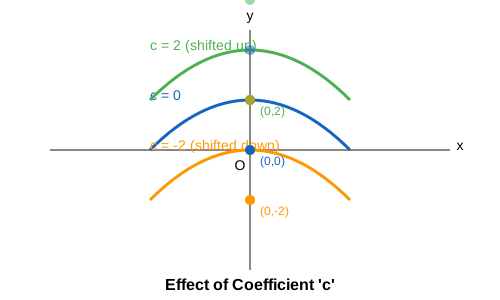
The coefficient 'c' represents the y-intercept and affects the vertical position of the entire parabola:
- When c increases, the entire parabola shifts upward
- When c decreases, the entire parabola shifts downward
- The y-intercept is always at the point (0, c)
Interactive Demonstration
Adjust the sliders to see how each coefficient affects the parabola's shape and position.
Applications of Coefficient Analysis
Understanding how coefficients affect parabolas is essential for various applications:
Physics: Projectile Motion
In projectile motion, the path of an object follows a parabolic trajectory described by y = -0.5g·t² + v₀·sin(θ)·t + h₀, where g is gravity, v₀ is initial velocity, θ is the angle, and h₀ is initial height.
Engineering: Suspension Bridges
The cables of suspension bridges form parabolas. Engineers adjust the "a" coefficient to control the height and tension of the cables.
Economics: Supply and Demand
In some economic models, quadratic functions model cost functions where the coefficient "a" represents how quickly marginal costs increase with production.
Quick Check
Test your understanding of coefficient effects:
If you want to make a parabola narrower, what should you do?
What determines the direction (upward or downward) of a parabola?
If c = 3, where does the parabola intersect the y-axis?
Graph Transformations
A quadratic function can be transformed in various ways to shift, stretch, compress, or reflect its graph. Understanding these transformations helps in analyzing and manipulating parabolas for various applications.
Standard Form vs. Vertex Form
To better understand transformations, we need to compare the standard form and vertex form of quadratic functions:
- Standard Form: f(x) = ax² + bx + c
- Vertex Form: f(x) = a(x - h)² + k, where (h, k) is the vertex
The vertex form is particularly useful for understanding transformations, as it directly shows how the parabola has been shifted from the origin.
Horizontal Translations
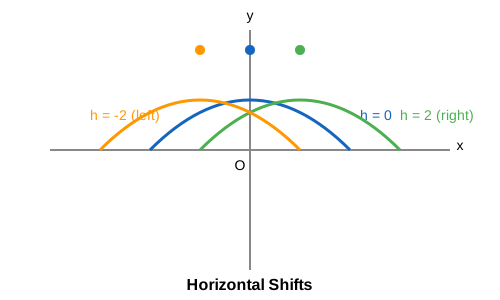
The graph of f(x) = a(x - h)² + k is shifted h units horizontally from the basic parabola f(x) = ax²:
- If h > 0, the parabola shifts h units to the right
- If h < 0, the parabola shifts |h| units to the left
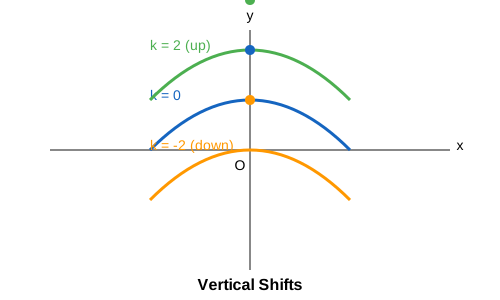
Vertical Translations
The graph of f(x) = a(x - h)² + k is shifted k units vertically from the basic parabola f(x) = ax²:
- If k > 0, the parabola shifts k units upward
- If k < 0, the parabola shifts |k| units downward
Vertical Stretching and Compression
The coefficient 'a' in f(x) = a(x - h)² + k affects the vertical stretching or compression of the parabola:
- If |a| > 1, the parabola is stretched vertically (becomes narrower)
- If 0 < |a| < 1, the parabola is compressed vertically (becomes wider)
- If a < 0, the parabola is also reflected across the x-axis (opens downward)
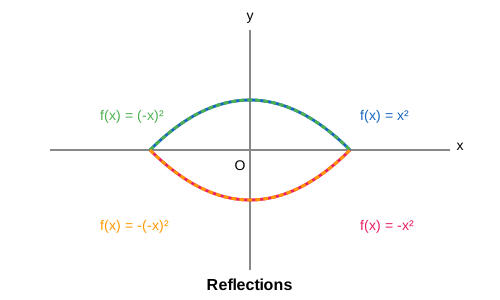
Reflections
Parabolas can be reflected across the x-axis or y-axis:
- Reflection across the x-axis: Replace f(x) with -f(x)
- Reflection across the y-axis: Replace x with -x in the function
Sequence of Transformations
When applying multiple transformations, the order matters. The conventional order is:
- Stretching/compression (multiplication by a)
- Reflection (if applicable)
- Horizontal translation (replace x with x - h)
- Vertical translation (add k)
Example: Transform f(x) = x² into g(x) = -2(x - 3)² + 4
This involves:
- Stretching by a factor of 2
- Reflection across the x-axis (negative sign)
- Horizontal shift 3 units to the right
- Vertical shift 4 units upward
Interactive Transformation Explorer
Adjust the sliders to see how different transformations affect the parabola.
Applications of Transformations
Understanding parabola transformations has practical applications:
Architecture
Arches and domes often follow parabolic shapes. Engineers can transform basic parabolas to achieve specific heights, widths, and structural properties.
Optics
Parabolic mirrors and lenses use transformed parabolas to focus light. The precise shape determines the focal point's position.
Physics
Projectile motion equations can be rewritten in vertex form to easily determine maximum height, distance traveled, and time in air.
Quick Check
Test your understanding of parabola transformations:
What is the vertex of the parabola f(x) = 2(x - 3)² + 4?
How would you transform the basic parabola f(x) = x² to get g(x) = -3(x + 2)² - 5?
If a parabola has vertex at (-2, 3) and opens downward with a vertical stretch of 4, what is its equation in vertex form?
Practical Applications
Quadratic equations and parabolas aren't just mathematical abstractions—they appear frequently in the real world. This module explores how quadratic functions model and solve problems in various fields including physics, engineering, architecture, economics, and everyday life.
Applications in Physics
Quadratic equations are fundamental in describing various physical phenomena:
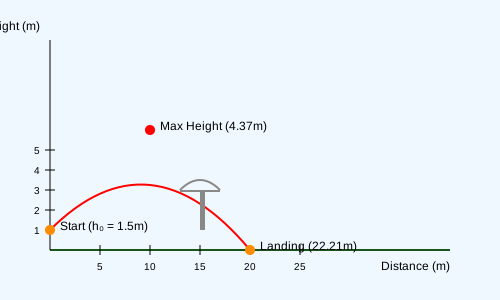
Projectile Motion
When an object is thrown or launched, its vertical position follows a quadratic function of time:
Where:
- h(t) is the height at time t
- g is the acceleration due to gravity (approximately 9.8 m/s²)
- v₀ is the initial vertical velocity
- h₀ is the initial height
Example: Basketball Shot
A basketball player shoots from an initial height of 2 meters with an initial velocity of 7.84 m/s. The height of the ball at time t seconds is given by:
From this equation, we can determine:
- The maximum height (at vertex)
- The time the ball is in the air
- When the ball reaches the height of the basket
Free Fall Motion
When an object falls under the influence of gravity, its position follows a quadratic equation:
Where s₀ is the initial position, v₀ is the initial velocity, and a is acceleration.
Applications in Engineering and Architecture
Parabolic shapes appear frequently in engineering structures and designs:
Suspension Bridges
The cables of suspension bridges form parabolas when the weight of the roadway is uniformly distributed horizontally. This shape distributes forces efficiently.
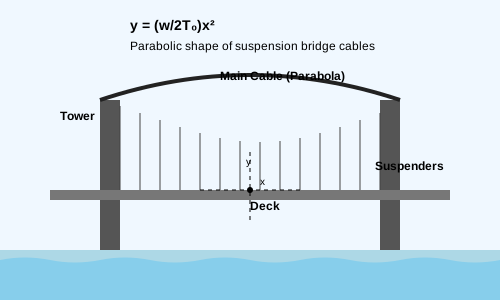
The equation of the cable curve can be modeled as:
Where T₀ is the tension at the lowest point and w is the weight per unit length.
Arches and Domes
Parabolic arches are structurally efficient and distribute weight evenly. They're used in architecture for bridges, entryways, and domes.
The Gateway Arch in St. Louis follows a weighted catenary, which is closely related to a parabola, and can be approximated by a quadratic function for many engineering purposes.
Parabolic Reflectors
Parabolic shapes are crucial in optics and signal technology:
- Satellite dishes use parabolic reflectors to focus incoming signals to a single receiver point
- Telescope mirrors use parabolic shapes to focus light
- Flashlights and headlights use parabolic reflectors to create a directed beam
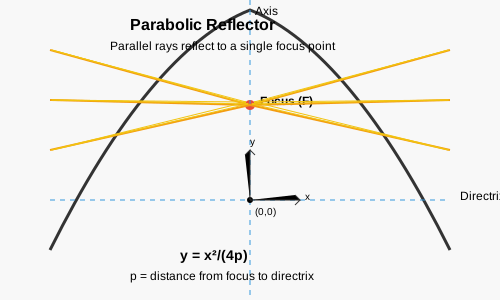
A key property: all rays parallel to the axis of a parabolic reflector will reflect to the focus.
Applications in Economics and Business
Quadratic functions model many economic relationships:
Revenue Optimization
The relationship between price and demand often follows a linear function, which leads to a quadratic revenue function:
Then revenue function: R = p·q = p(a - bp) = ap - bp²
To maximize revenue, companies can find the vertex of this quadratic function.
Example: Ticket Pricing
A theater finds that when tickets are priced at $10, they sell 500 tickets. For each $1 increase in price, they sell 20 fewer tickets. The revenue R as a function of the price increase x is:
The optimal price increase can be found by determining the x-coordinate of the vertex.
Profit Maximization
Profit functions frequently take quadratic form when revenue and cost functions are considered:
If revenue is quadratic and cost is linear (or has a quadratic component), the resulting profit function will be quadratic.
Production and Cost
In manufacturing, the marginal cost often increases with production volume, leading to quadratic cost functions:
Where C(q) is the total cost to produce q units, c is the fixed cost, and the quadratic term represents increasing marginal costs at higher production levels.
Environmental and Biological Applications
Quadratic relationships occur naturally in many biological and environmental systems:
Population Growth
While exponential models are common for population growth, quadratic models can represent populations with resource constraints:
This can model scenarios where growth initially accelerates but then decelerates as resources become limited.
Chemical Reactions
Some chemical reactions follow second-order kinetics, which can be modeled using quadratic equations.
Interactive Problem-Solver
Explore how to apply quadratic equations to solve real-world problems in this interactive sandbox:
Basketball Throw Simulator
Adjust parameters to see how they affect the trajectory of a basketball throw.
Resulting Equations:
Horizontal position: x(t) = v₀·cos(θ)·t
Vertical position: y(t) = h₀ + v₀·sin(θ)·t - 4.9t²
Trajectory Analysis:
Maximum Height: 0.0 m
Time in Air: 0.0 s
Horizontal Distance: 0.0 m
Ticket Pricing Simulator
Find the optimal ticket price to maximize revenue for your event.
Resulting Equations:
Demand Equation: q = 500 - 20p
Revenue Equation: R = p(500 - 20p) = 500p - 20p²
Revenue Analysis:
Optimal Price: $0.00
Maximum Revenue: $0.00
Tickets Sold: 0
Fencing Problem Simulator
Find the dimensions that maximize the area of a rectangular field given a fixed amount of fencing.
Resulting Equations:
Perimeter Equation: 2x + 2y = 100
Length Equation: y = (100 - 2x)/2 = 50 - x
Area Equation: A = x·y = x(50-x) = 50x - x²
Area Analysis:
Current Width: 0.0 m
Current Length: 0.0 m
Current Area: 0.0 m²
Optimal Dimensions: 0.0 × 0.0 m
Maximum Area: 0.0 m²
Quick Check
Test your understanding of practical applications:
A ball is thrown upward from a height of 1.5 meters with an initial velocity of 19.6 m/s. Which equation represents its height h (in meters) after t seconds?
A company finds that when they price their product at $p dollars, they sell q = 1000 - 25p units. Which price maximizes their revenue?
Which of the following real-world structures most clearly demonstrates parabolic shapes?
Case Studies
Explore these in-depth examples of quadratic equations solving real-world problems:
Golden Gate Bridge Design
How engineers used quadratic equations to model the suspension cables of the Golden Gate Bridge, accounting for weight distribution, wind forces, and tension.
Read Case StudySolar Farm Optimization
How a renewable energy company used quadratic functions to determine optimal spacing of solar panels to maximize energy collection while minimizing land use.
Read Case StudySmartphone App Pricing Strategy
How a mobile app developer used quadratic revenue models to determine the optimal price point for their premium features, balancing volume and price.
Read Case Study